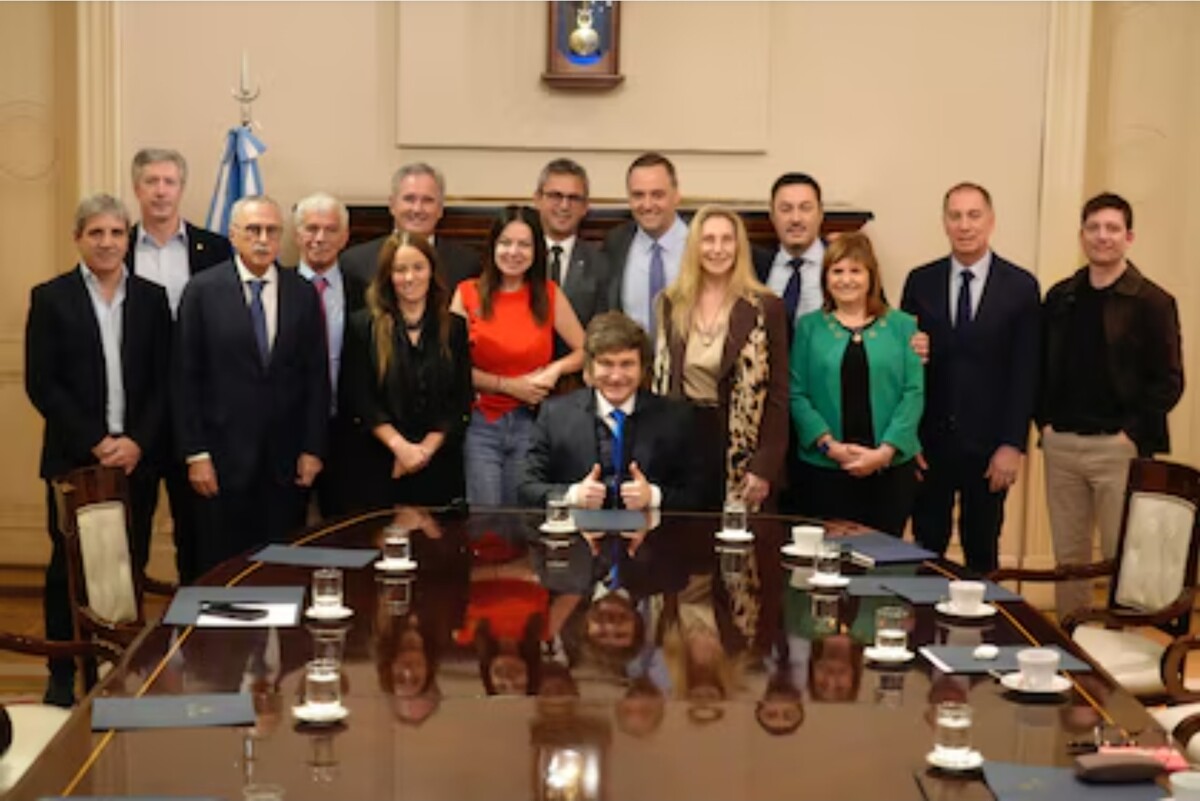
According to press coverage, the decree was signed by the President in the late hours of Wednesday for its official publication on Thursday. In addition to the transfer of RENAPER (National Registry of Persons), it was determined that the Undersecretariat of Sports would fall under the orbit of the Interior Ministry, while the Tourism and Environment portfolios will, for now at least, remain under the leadership of the Chief of Cabinet of Ministers, Manuel Adorni.
For now, the reordering structures—but does not complete—the architecture that Milei needs to deploy his management plan. Official sources state that the priority is to avoid 'rushed appointments' and to favor profiles that 'accompany the new management logic'.
In this context, the ministerial reorganization sends signals of an administration seeking to strengthen its core of political and operational design before accelerating the upcoming key reforms, including tax, labor, and public spending control reforms.
At the same time, the management of the Interior Ministry sees its capacity for dialogue with the provinces and Congress reinforced, a key axis for the reformist roadmap that the Casa Rosada seeks to implement.
The moment is not without tensions: on the one hand, the need to fill executive posts generates expectation and political pressure; on the other, the reorganization of the Executive Branch reveals Milei's will to imprint his mark on the state's structure, even if this implies leaving provisional vacancies and even resigning appointment deadlines.
There are still posts that lack responsible persons or for which replacements are expected in the coming weeks. In this context, the current Minister of Tourism, Daniel Scioli, maintains these areas, albeit with greater supervision.
Although the macro-level changes in the structure have already been implemented, the appointment of heads for at least three secretariats within the Chief of Cabinet's office is still pending, including the Secretariat for Strategic Affairs—responsible for coordinating between Defense, Security, and Intelligence—and the Secretariat for Parliamentary and Institutional Relations.
In the first case, a name has allegedly already been selected, although his assumption of office could be delayed until March. In the second case, the current figure, Oscar Moscariello, does not have the support of the Head of Cabinet for his continuity. Furthermore, the structure of the Secretariat of Innovation, Science, and Technology remains under its current head, Darío Genua, but the transfer of several of the agencies he coordinates—such as the Agency for the Promotion of Research, the Genetic Data Bank, the National Commission for Space Activities, CONICET, and ENACOM—to another ministry is being evaluated to reorganize the internal power of the cabinet.
Among the most significant internal effects is a clear focus on unburdening Adorni in the Chief of Cabinet's office, allowing him to focus on both management audits in the ministries and ensuring the deadlines set by the President for the second half of his term.